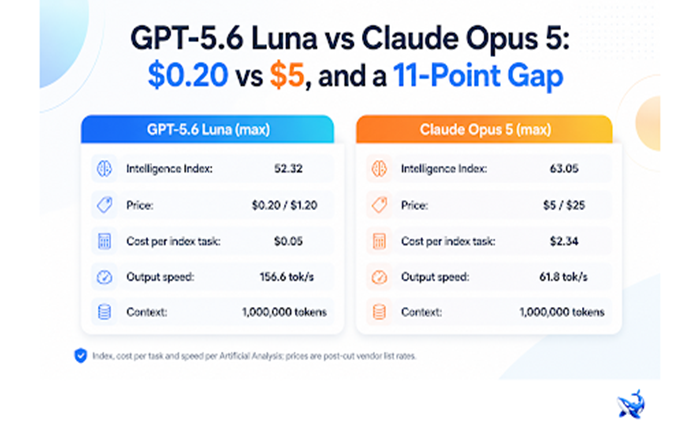
On raw capability, GPT-5.6 Luna API and Claude Opus 5 are both max-config reasoning models with a million-token context window — 52.32 against 63.05 on Artificial Analysis’ Intelligence Index — but on price they are different species: $0.20 per million input tokens after OpenAI’s cut versus $5 (Anthropic’s list), a 25× gap, and $0.05 versus $2.34 per finished index task. The stronger model is eleven points up on the board and roughly 47× more expensive per completed task, which makes this less a model comparison than a routing decision. The rival’s rate card and telemetry are on GPT-5.6 Luna.
If you plan this comparison by reading rate cards alone, you will pick one model and miss half the problem. Reasoning models bill their thinking as output tokens, so the number that predicts your invoice is never the per-token rate — it is the cost of a finished unit of work. Measured that way, these two models are the bookends of the current reasoning market, and most production traffic belongs to both of them, in different proportions.
The scoreboard
Every figure below is the max configuration; Artificial Analysis publishes max scores unless stated otherwise. Luna’s max is 52.32 — dropping to 50.06 at xhigh and 46.96 at high effort — and Opus 5’s 63.05 is likewise its max. Compare like for like.
| Metric | GPT-5.6 Luna (max) | Claude Opus 5 (max) |
| Intelligence Index (Artificial Analysis, live board) | 52.32 | 63.05 |
| List price per 1M tokens, input / output | $0.20 / $1.20 (post-cut) | $5 / $25 |
| Cached input per 1M (Anthropic list) | — | $0.50 |
| Cost per Intelligence Index task (Artificial Analysis) | $0.05 | $2.34 |
| Median output speed (Artificial Analysis) | 156.6 tok/s | 61.8 tok/s |
| Context window (Artificial Analysis) | 1,000,000 tokens | 1,000,000 tokens |
| Time to first token | ~102 ms (Artificial Analysis) | p50 7.34 s (OrcaRouter telemetry) |
| Omniscience (vendor-reported) | — | 37.07 |
Prices are list rates: Luna’s are the post-cut figures passed through on OrcaRouter at 0% markup; Opus 5’s are Anthropic’s. Read the table left-to-right for capability and right-to-left for cost, and you have the whole argument of this article: the gap is one of price and throughput, not of class.
The context window is the one genuine tie — both carry a million tokens, so neither loses the long-context debate out of the box. One transparency note: at least one external listing has quoted Luna at $0.10 / $0.60 with a separate tier above 272,000 prompt tokens; our catalog and Artificial Analysis both read $0.20 / $1.20, and that is the reference we use throughout.
Why the token price under-reports the gap
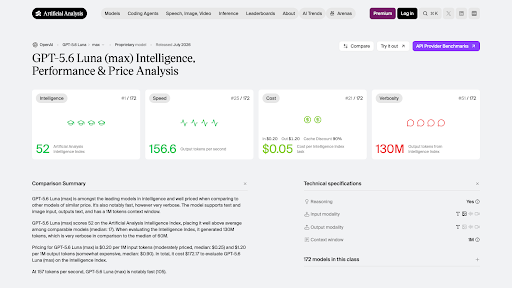
Input is 25× cheaper on Luna after the cut ($0.20 versus $5); output is roughly 21× cheaper ($1.20 versus $25). Yet even that understates the real gap, because the finished-task figure factors in how much each model writes. Artificial Analysis measured Luna consuming 130 million output tokens to complete the full Intelligence Index — more than double the tier median of 60 million — at a total run cost of $172.17, which ranks it #21 of 172 on cost and makes it the cheapest model on the board per task. Opus 5 costs $2.34 per single index task. Same benchmark, same questions, 47× apart per unit of completed work.
Cache changes the picture slightly for Opus 5. Its cached input is $0.50 per million tokens (Anthropic list price) — a 90% discount off the $5 headline — which matters when you re-send the same long documents repeatedly. Luna’s pricing after the cut is already low enough that caching moves the needle less.
Where GPT-5.6 Luna wins: the volume workhorse
At $0.05 per task, with a ~102 ms first token (Artificial Analysis) and 156.6 tokens per second of output — two and a half times Opus 5’s 61.8 — Luna is engineered for throughput, not deliberation. That is exactly what high-volume production needs: extraction, classification, tagging, summarisation, routing, synthetic data, and the enormous middle class of tasks that are individually simple and run millions of times.
The usage data says teams already trust it in hot paths. In OrcaRouter’s seven-day production telemetry, Luna moved 21,271.6 million tokens against Opus 5’s 491.5 million — by far the highest-volume model in the set. Traffic is not a quality ranking, but a 43× difference is a strong signal about which model engineers are comfortable calling synchronously in front of a user, and which one they queue up for the hard jobs.
Where Claude Opus 5 earns the premium: hard reasoning
Eleven index points is not a rounding error. On the work where an extra point is worth real money — multi-step agentic tasks, adversarial math, long-horizon document reasoning — Opus 5’s 63.05 is the ceiling Luna is not. Anthropic’s own Omniscience figure puts it at 37.07, and the cached-input discount at $0.50 per million makes repeated long-context calls far cheaper than the $5 headline implies.
None of that makes Opus 5 the right default. It earns its price only on the small slice of traffic where a wrong answer is expensive — exactly the slice where teams run it at deliberately low volume. Its median first token in our telemetry is 7.34 seconds, which is the profile of a background-job model, not a user-facing one. That is a feature when the job is “work through this hard problem and get it right”; it is a tax when a human is waiting on the answer.
The routing decision matters more than the model choice
The 11-point index gap against the 25× input price gap is not a tie — it is a menu. The cheapest possible setup is Luna for everything, and it is wrong: hard reasoning pays for itself when the answer is worth $2.29. The most capable setup is Opus 5 for everything, and it is wrong too: a $0.05 task does not need a 63.05 ceiling, and the bill will show it.
The rule that wastes the least money is to stop choosing and start routing: send routine volume to Luna, escalate hard reasoning to Opus 5 on a validation failure, a low-confidence signal, or an explicit “this is the hard one” flag. A batch pipeline, for instance, runs 999 extraction jobs on Luna and only the flagged outlier goes to Opus 5 — the quality of the expensive model where it matters, the price of the cheap one almost everywhere else.
That policy is a routing decision, not a model decision — and it is the one that actually moves your invoice. It becomes configuration rather than a second integration when both models sit behind one OpenAI-compatible endpoint on a single key: OrcaRouter carries both — plus 200-plus other models — at 0% markup, passing provider list prices straight through, so the cheap-to-expensive split is a rule in your code, not a second pipeline to maintain.
The takeaway
Buy the index gap only where it pays for itself. Routine volume — extraction, classification, tagging, summarisation, synthetic data — belongs on Luna at $0.05 per task and 156.6 tokens per second. Hard reasoning — the slice of work where an extra index point is worth $2.29 — belongs on Opus 5. The routing decision matters more than the model choice: the teams that win on cost are not the ones that picked the cheaper model, they are the ones that picked both and routed between them.
Sourcing note: Intelligence Index scores, cost per index task, output-token counts, total run cost, cost rank, output speed and Luna’s ~102 ms first-token are from Artificial Analysis’ live pages, checked August 22, 2026; Opus 5’s median first token (7.34 s) and the seven-day token volumes are OrcaRouter production telemetry. Luna’s pricing is the post-cut list price ($0.20 / $1.20, down from the $1 / $6 launch price) passed through at 0% markup; Opus 5’s $5 / $25 and $0.50 cached input are Anthropic list prices. The Omniscience 37.07 figure is vendor-reported. All benchmark figures are max-config.